Part 2 of the Discover. Assess. Protect. series
The problem in most OT security programs is not finding risk. It is acting on what you find.
What “Assess” actually means
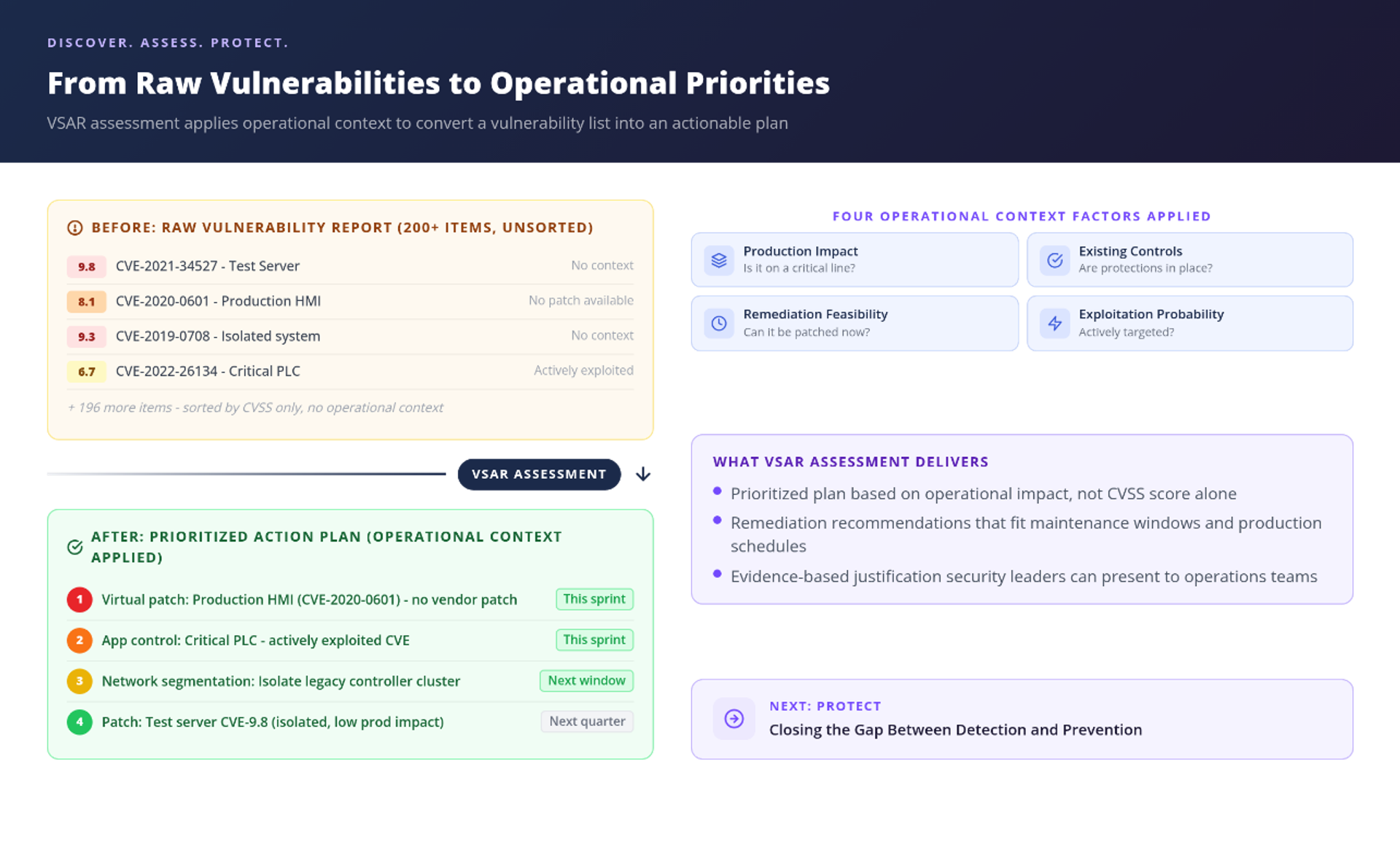
Assessment transforms raw discovery data into operational priorities. It answers the question every security leader asks after seeing their OT vulnerability report: what should we fix first, and what can we realistically do this quarter?
Effective OT assessment accounts for context that generic vulnerability scanners miss:
- Production impact scoring evaluates vulnerabilities by their effect on production, not just their CVSS severity. A critical vulnerability on a test system is categorically different from the same vulnerability on a production line.
- Exploitation probability factors in real-world attack telemetry and threat intelligence. Not every vulnerability is actively exploited; assessment separates theoretical risk from operational urgency.
- Existing controls evaluation identifies protections already in place (network segmentation, application control, inline prevention) that reduce exposure, avoiding unnecessary changes that disrupt operations.
- Remediation feasibility considers patch availability, maintenance windows, and operational constraints. Assessment recommends what can be done, not just what should be done.
TXOne’s VSAR methodology combines these factors into a single prioritized improvement plan tailored to each organization’s operational reality.
Why operational context changes everything
In OT environments, a security patch that disrupts a production line can cost more than the vulnerability it addresses. This is not an irrational fear. It is operational reality. And it is why vulnerability reports end up sitting in spreadsheets while the risk remains active.
Effective assessment bridges the gap between security teams and operations teams. When remediation recommendations account for maintenance windows, production schedules, and existing protections, operations teams approve them. When they do not, nothing happens.
For IT security leaders, this distinction is career-defining. Your security program is measured by risk reduction, not by the length of your vulnerability report. Every system in your environment deserves active defense, not static risk acceptance. Assessment converts discovery findings into a plan that delivers measurable progress, including protection strategies for systems with no vendor patch.
The gap between assessment and protection
A prioritized remediation plan is a significant improvement over an unsorted vulnerability list. But assessment alone does not stop a threat that arrives tomorrow.
Ransomware does not wait for your next maintenance window. When a threat executes faster than your remediation cycle, you need protection that works in real time, not on a quarterly schedule.
Next in the series: Protect: Closing the Gap Between Detection and Prevention
Ready to start? SenninRecon deploys passively to assess your OT environment and deliver a VSAR-scored improvement plan, with results in days and no operational disruption.
Tags
About the Author
At the heart of Dan’s mission is the belief that OT security should empower businesses to operate without compromise, balancing risk management with operational integrity. His insights have helped organizations reframe security challenges, ensuring their solutions are as practical as they are innovative.