Operational Technology (OT) cybersecurity is the practice of protecting the industrial control systems, physical processes, and connected OT networks that run factories, power grids, water systems, and transportation infrastructure. Where IT security protects data, OT cybersecurity protects the machinery and processes that data controls — and the safety of the people working alongside them.
That difference changes everything about how security must be designed. An IT outage delays a report. An OT outage stops a production line, halts a turbine, or creates a safety event.
This guide explains what makes OT security distinct, why a strong IT foundation is a prerequisite rather than a competitor, and how to build a practical OT security program that aligns technical defenses with operational and business goals.
What Is OT Cyber Security?
OT cyber security is the practice of protecting operational technology — the hardware and software that monitors and controls physical processes — from cyber threats. It covers industrial control systems, connected plant equipment, and the OT networks that link them, with the goal of keeping industrial operations safe, reliable, and continuously available.
Unlike IT security, which is organized around protecting data, OT cyber security is organized around protecting a process. A compromised database leaks information. A compromised programmable logic controller can open a valve, overheat a reactor, or stop a line.
That reordering of priorities is the whole discipline. In IT, the classic priority order is confidentiality, integrity, availability. In OT, it inverts: availability and safety come first, then integrity, then confidentiality.
What Does OT Security Stand For? Definition and Meaning
OT security stands for Operational Technology security. It refers to the practices, technologies, and policies used to protect industrial control systems, physical processes, and connected operational assets from cyber threats.
The meaning of OT security is best understood by contrast with IT security. IT security protects information — records, transactions, communications. OT security protects the systems that make physical things happen: the pumps, turbines, robots, conveyors, and safety instrumented systems that constitute a plant.
In practice, OT security means reducing cyber risk without reducing operational availability. A control that stops an attack but also stops production has not solved the problem; it has relocated it.
What Is Operational Technology (OT)?
Operational technology is the hardware and software that detects or causes changes in physical processes through direct monitoring and control of industrial equipment. OT includes the controllers, sensors, actuators, and supervisory systems that run manufacturing plants, energy generation and distribution, water treatment, transportation, and building systems.
Typical operational technology includes:
- Programmable Logic Controllers (PLCs) — ruggedized industrial computers that execute control logic, such as operating the valves in a chemical plant
- Supervisory Control and Data Acquisition (SCADA) systems — supervisory platforms that monitor and control geographically distributed assets like pipelines and power grids
- Distributed Control Systems (DCS) — process control systems for a single site such as a refinery or paper mill
- Human-Machine Interfaces (HMIs) — the operator-facing screens used to observe and command a process
- Remote Terminal Units (RTUs) — field devices that collect telemetry from remote locations
- Safety Instrumented Systems (SIS) — independent systems that bring a process to a safe state when limits are exceeded
Operational technology security — often written as operational technology cyber security — applies to all of the above plus the networks connecting them.
What Is an OT Network?
An OT network is the communications infrastructure that connects industrial control devices — PLCs, HMIs, RTUs, sensors, and actuators — to each other and to supervisory systems. It carries the commands that operate physical equipment and the telemetry that reports process state.
OT networks differ from IT networks in three important ways:
- They run industrial protocols. Modbus, DNP3, EtherNet/IP, PROFINET, OPC UA, and IEC 61850 dominate, and most were designed for reliability in a closed environment rather than for authentication or encryption.
- They are latency- and determinism-sensitive. A control loop that expects a response in milliseconds cannot tolerate the jitter introduced by some conventional security appliances.
- They have long lifecycles. Network equipment and endpoints commonly remain in service for 15 to 25 years, far beyond the support life of the software they run.
Because industrial protocols largely lack native authentication, OT network security depends heavily on architecture: segmenting the network into zones and conduits, controlling what may cross between them, and inspecting industrial traffic for commands that are syntactically valid but operationally wrong. Effective OT network security also means monitoring east-west traffic inside the plant, not just north-south traffic at the perimeter — most consequential OT incidents involve movement within the environment after an initial foothold.
OT Devices and OT Systems Explained
OT devices are the individual physical components that sense, control, or act on an industrial process. OT systems are the integrated combinations of those devices — a SCADA system, a DCS, a safety system — that together perform a control function.
The security-relevant characteristics of OT devices are consistent across industries:
- Many cannot be patched without scheduled downtime, and some cannot be patched at all
- Many run end-of-life operating systems such as Windows XP, Windows 7, or Windows 2000
- Most have no capacity to host a conventional security agent
- Most communicate in cleartext using protocols without authentication
- Replacement cycles are measured in decades and capital budgets, not refresh cycles
This is why OT security emphasizes compensating controls — segmentation, virtual patching, allowlisting, inspection at the point of entry — rather than the patch-and-update rhythm that IT security relies on.
IT vs OT: What's the Difference?
Operational Technology (OT) refers to all the hardware and software that controls physical processing systems. Think of Programmable Logic Controllers (PLCs) operating the valves at a chemical factory, Supervisory Control and Data Acquisition (SCADA) systems watching over a pipeline, or Distributed Control Systems (DCS) coordinating the assembly line at a plant. Such systems are the lifeblood of manufacturing, energy, and utilities, and are designed to keep operations like oil refining or electricity delivery moving along without a hitch.
Information Technology (IT), on the other hand, is all about data management and protection. Think of corporate databases, email servers, or cloud platforms. It focuses on the needs of business users such as accountants or marketers who require private, correct, and available data. OT is all about the availability and integrity of physical processes. Plant operators and engineers are best equipped to maintain these operations.
IT Security is like fortifying a digital fortress: Firewalls, antivirus software, and quick patches to keep compromises out. Systems may often be revised overnight with little to no disruption. In contrast, OT cybersecurity operates in a more intricate environment. Many OT systems rely on legacy PLCs or SCADA setups dating back to the 1980s and 1990s. These systems were installed before today’s cyber threats even existed, so they lack built-in security.
Updating them is risky, with potential downtime that could cost millions and endanger workers. For example, shutting down turbines at a power plant during peak demand could have serious consequences. The stakes are higher in OT. Failures can lead to serious physical consequences, like a downed water treatment plant or a manufacturing error that causes equipment failure. For example, IT secures patient records in hospitals, while OT keeps vital systems like ventilators and HVAC units running. This fundamental difference underpins OT’s cybersecurity goal to focus on operational availability.
IT focuses on data confidentiality and control. In contrast, OT aims for continuous operation. This tension needs to be resolved with teamwork and cooperation. Plant managers, who understand daily operations, should work with the IT department to set priorities. A factory may need 24/7 operations to meet production goals, while IT may push for stricter network controls.
Before any programs are affected, stakeholders must agree on goals. These could include keeping the lights on, ensuring safety, or defining acceptable operational limits. Once these goals are clear, they can implement effective security controls in the plant. This teamwork ensures that security supports the operations team rather than hinders it. A united approach is essential for OT security.
IT as the Bedrock of OT Protection
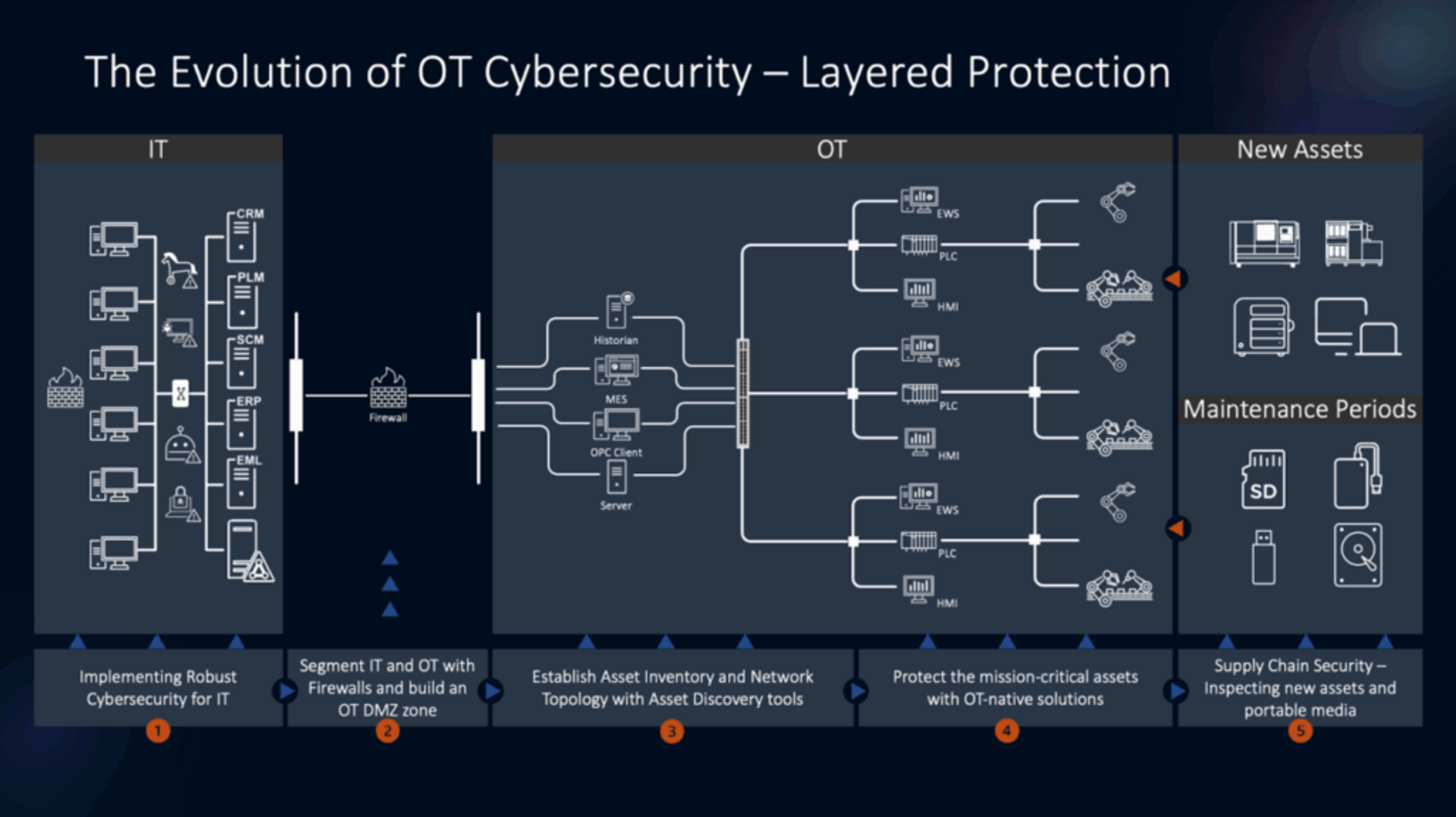
Merging IT security practice with OT is not a matter of extending existing tooling. IT expects frequent change; OT prioritizes stability. Restarting a DCS to apply a patch can disrupt output and waste a maintenance window.
Involving operations teams early is what makes the difference. Security measures — including workarounds for systems that cannot be patched — need to be designed against real business goals: keeping a refinery running, protecting workers, hitting a production target.
At the same time, a weak IT environment makes OT security impossible. An insecure VPN, a compromised corporate laptop, or a successful phishing attempt against an engineer's account is the most common route into an OT environment. IT is typically the first target, not the final one. Access control, identity management, email security, and network monitoring on the IT side are prerequisites for OT security, not alternatives to it.
Security in OT must also balance protection against flexibility. An engineer may need remote access to a turbine during an emergency; if access is too restricted, safety actions get delayed. Allowing broader access — routine remote access for OEM vendors, for example — improves operations but expands the attack surface. The resolution is not to pick one, but to make access controlled, monitored, and revocable.
OT vs ICS vs IIoT vs CPS: Clearing Up the Terminology
These four terms overlap and are frequently used interchangeably. They are not synonyms.
| Term | What it means | Relationship |
|---|---|---|
| OT (Operational Technology) | The broadest term: all hardware and software that monitors or controls physical processes | The umbrella category |
| ICS (Industrial Control Systems) | The control systems specifically — SCADA, DCS, PLCs, safety systems | A major subset of OT |
| IIoT (Industrial Internet of Things) | Network-connected industrial sensors and devices that send data to analytics or cloud platforms | Newer devices, often layered onto existing OT |
| CPS (Cyber-Physical Systems) | Any system where computation and networking are integrated with physical processes | The widest framing; includes OT, ICS, IIoT, plus medical devices, building systems, and connected vehicles |
In practice, "ICS security" and "OT security" are often used to mean the same work. "CPS security" is the term increasingly used by analysts because it also covers healthcare, building automation, and transportation environments that are not industrial in the traditional sense.
OT Security Challenges and Risks
OT environments face a specific set of constraints that make them harder to secure than IT environments — not because the threats are more sophisticated, but because the usual remedies are unavailable.
- Legacy and outdated systems. Many SCADA, PLC, and DCS components were designed decades ago, before network threats existed. They frequently run unsupported operating systems and have no built-in authentication or encryption.
- IT/OT integration. Connecting plant networks to corporate networks creates a path for malware to move from a compromised laptop to the factory floor.
- Remote access requirements. Maintenance contracts often require vendor or engineer access to equipment. Each access path is a potential entry point.
- Operational limitations on patching. Applying patches requires downtime that may not be available for months. Systems remain knowingly vulnerable in the interim, which means compensating controls have to carry the load.
- Limited visibility. Many organizations cannot produce an accurate inventory of what is actually connected to their OT network — and you cannot protect what you have not catalogued.
- Scarce OT security skills. The intersection of control engineering and cybersecurity is a small talent pool, and IT security staff are rarely trained on the operational consequences of their actions.
The stakes follow from the physics. A compromised PLC could alter a batch of chemicals, producing defective product or an unsafe condition. The goal is not to eliminate these constraints — most are permanent — but to design a program that works within them.
The Air Gap Myth: Why Isolated OT Networks Still Get Breached
A true air gap — a network with no physical or logical connection to any other network — is rare in modern industrial operations, and even genuine air gaps do not prevent compromise.
Air-gapped environments are routinely breached through the paths that remain open:
- Removable media. USB drives carried in by contractors and engineers remain one of the most reliable delivery mechanisms into isolated environments. Stuxnet is the canonical example.
- Vendor laptops. Maintenance engineers connect the same laptop to multiple customer sites.
- New equipment. Machinery can arrive from the supplier already carrying malware from the integrator's staging environment.
- Undocumented connections. Cellular modems, wireless bridges, and temporary links added for a project and never removed.
The practical response is to treat every asset and every piece of media crossing the boundary as untrusted until inspected — scanning devices and media before they touch the plant network — rather than relying on the isolation itself.
The Impacts of IT-OT Convergence and Integration
IT-OT convergence has genuinely changed industrial operations. Real-time analytics optimize production, and engineers can diagnose systems remotely. It has also removed the isolation that OT environments implicitly depended on.
Connecting factory controls to a corporate network introduces exposure to ransomware, commodity malware, and targeted intrusion — threats that can now reach physical processes.
The MITRE ATT&CK for ICS framework is useful here. It catalogues the tactics and techniques adversaries actually use in OT environments — exploiting remote services, manipulating control logic, inhibiting response functions — which lets teams prioritize defenses against observed behavior rather than hypothetical risk.
The 2019 Norsk Hydro incident illustrates the pattern. LockerGaga ransomware entered through IT, spread across the enterprise, and forced the aluminum producer to move several plants to manual operation. Hydro publicly estimated the financial impact at NOK 550–650 million for the first quarter of 2019 alone (roughly US$60–71 million at the time). The initial infection reportedly arrived via a compromised email from a trusted customer.
The OT Threat Landscape: Notable OT Cyberattacks
A series of documented incidents shows how OT threats have evolved from opportunistic spillover to purpose-built industrial attack tooling.
| Year | Incident | Sector | Initial vector | OT impact |
|---|---|---|---|---|
| 2010 | Stuxnet | Nuclear enrichment | Removable media | Manipulated PLCs controlling centrifuges; physical damage |
| 2015 | BlackEnergy (Ukraine) | Electric grid | Spear-phishing → IT → OT | Confirmed outage; approximately 225,000 customers lost power |
| 2016 | Industroyer / CrashOverride (Ukraine) | Electric grid | Purpose-built ICS malware | Outage in Kyiv; malware spoke grid protocols natively |
| 2017 | Triton / TRISIS | Petrochemical | Compromised engineering workstation | Targeted a Schneider Electric Triconex safety instrumented system — the first malware aimed at defeating a safety system |
| 2017 | NotPetya | Multiple (shipping, pharma, food) | Compromised software update | Destroyed IT estates; halted terminals and plants worldwide |
| 2018 | VPNFilter | Networking (broad) | Router vulnerabilities | Compromised roughly 500,000 routers, including at industrial sites |
| 2019 | LockerGaga (Norsk Hydro) | Metals manufacturing | Phishing → IT | Forced manual operation across multiple plants |
| 2021 | Colonial Pipeline | Fuel distribution | Compromised VPN credential | IT systems encrypted; pipeline shut down precautionarily |
| 2022 | Industroyer2 (Ukraine) | Electric grid | Sandworm; staged ICS payload | Detected and neutralized before execution — no outage occurred |
| 2023 | Municipal water utilities (US) | Water | Internet-exposed PLCs with default credentials | Unitronics PLCs defaced; localized operational disruption |
The Colonial Pipeline Incident: A Case Study on OT Security
Colonial Pipeline remains the most disruptive publicly disclosed cyberattack on U.S. energy infrastructure to date. The DarkSide group gained access on May 7, 2021 through a compromised VPN password on an account that did not have multi-factor authentication enabled, exfiltrated data, and deployed ransomware that crippled IT systems including billing and accounting.
Critically, the OT systems that physically operate the pipeline were not the systems encrypted. Colonial shut the pipeline down as a precaution — in part because it could not confidently bill for product delivered. Operations resumed on May 12, 2021.
The lesson is the one that matters most for OT security programs: an attack does not have to reach OT to stop production. Where IT and OT are operationally interdependent — for billing, scheduling, logistics, or dispatch — an IT-only compromise can still force a physical shutdown. This is why IT/OT boundary architecture and incident-response planning need to be designed together.
A note on two commonly cited incidents. The 2021 Oldsmar water treatment case is widely repeated as a remote-access attack on a water supply. A subsequent FBI investigation did not confirm a targeted intrusion, and in 2023 the former city manager attributed the event to employee error. We do not cite it as a confirmed attack. Similarly, SolarWinds (2020) was a supply-chain compromise of an IT management platform; there is no public, confirmed evidence that attackers reached or manipulated utility OT systems through it. It remains a valid illustration of supply-chain risk to organizations that operate OT, not of an OT compromise.
The Purdue Model and OT Network Architecture
The Purdue Model is a reference architecture that organizes industrial control networks into hierarchical levels, from physical process equipment up to enterprise IT systems. It remains the most widely used framework for planning OT network segmentation.
| Level | Name | What lives there |
|---|---|---|
| Level 0 | Physical process | Sensors, actuators, valves, motors, drives |
| Level 1 | Basic control | PLCs, RTUs, safety instrumented systems |
| Level 2 | Area supervisory control | HMIs, local SCADA servers, engineering workstations |
| Level 3 | Site operations | Historians, MES, production scheduling, site-wide control |
| Level 3.5 | Industrial DMZ | Jump servers, patch and antivirus distribution, data brokers |
| Level 4 | Site business planning | Site-level IT, ERP clients, email |
| Level 5 | Enterprise | Corporate IT, cloud services, internet |
The Level 3.5 industrial DMZ is the architectural core of the model: no direct traffic passes between Levels 4–5 and Levels 0–3. Everything is brokered.
Two caveats matter in 2026. First, IIoT devices and cloud connectivity frequently bypass the hierarchy by design — a sensor that reports directly to a cloud analytics platform does not respect Purdue levels. Second, the model describes network architecture, not trust; flat segments inside a level are extremely common. The Purdue Model should be treated as a planning aid to be supplemented with zone-and-conduit design under IEC 62443, not as a security control in itself.
OT Cybersecurity Frameworks and Standards You Need to Know
Standards provide structure for OT security work and are often necessary for audits and regulatory obligations. They are means, not ends.
NIST Cybersecurity Framework (CSF) 2.0
NIST CSF 2.0, released in February 2024, is built around six functions: Govern, Identify, Protect, Detect, Respond, and Recover. The addition of Govern in version 2.0 is significant for OT, because it makes risk appetite and accountability explicit — the questions that determine how much operational disruption an organization will accept in exchange for security.
IEC 62443
IEC 62443 is the principal international standard for Industrial Automation and Control Systems security. It is organized by audience — asset owners, system integrators, and product suppliers — and introduces the zone and conduit model for segmentation along with Security Levels (SL 1–4) that express the strength of adversary a control is designed to resist.
MITRE ATT&CK for ICS
The MITRE ATT&CK for ICS matrix catalogues adversary tactics and techniques observed in operational environments. Its practical value is prioritization: it lets teams defend against what attackers actually do rather than distributing effort evenly across theoretical risks.
NERC CIP, NIS2, TSA and Other Regional OT Regulations
Regulatory obligations increasingly mandate OT security controls:
- NERC CIP — mandatory and enforceable for North America's Bulk Electric System. See our NERC CIP compliance guide.
- NIS2 — EU directive extending cybersecurity obligations across essential and important entities, including manufacturing.
- TSA Security Directives — requirements for U.S. pipeline and rail operators.
- SEMI E187 / E188 — semiconductor manufacturing equipment security specifications.
These frameworks are complementary. Security effort should be calibrated to the organization's risk tolerance and operational goals: overinvesting in complex controls slows operations, while underinvesting leaves exposure. A plant might apply IEC 62443 zone segmentation to isolate PLCs without disrupting production schedules — the standard supplies the structure, and the operations team supplies the constraints.
OT Security Best Practices Checklist: 6 Core Practices for a Strong Cybersecurity Program
An effective OT security program should improve process reliability and reduce unplanned downtime, not trade one for the other. These six practices form a practical checklist.
| # | Practice | Primary outcome |
|---|---|---|
| 1 | Asset-centric security across the lifecycle | Nothing enters the plant unverified |
| 2 | OT network segmentation | Contains an incident to one zone |
| 3 | Asset inventory and passive discovery | You can see what you own |
| 4 | Secure remote access with MFA | Vendor and engineer access is controlled and revocable |
| 5 | Compensating controls for unpatchable systems | Legacy assets stay protected without downtime |
| 6 | OT security monitoring and threat detection | Abnormal behavior is caught before it reaches the process |
1. Asset-Centric Security
Protect assets by securing every stage of their lifecycle rather than defending only the network around them. This begins at onboarding: equipment, laptops, and removable media should be scanned and verified malware-free before being granted access to the shop floor. Staging, production, and maintenance each need equivalent controls.
2. OT Network Segmentation
Divide OT networks into isolated zones — separating a DCS from IT networks, and separating production cells from one another — with defined conduits for the traffic that must cross between them. Segmentation is what converts a plant-wide incident into a single-cell incident. Where full re-architecture is impractical, micro-segmentation at the device level can deliver much of the containment benefit without re-cabling.
3. OT Asset Inventory & Passive Discovery
Identify every PLC, HMI, RTU, historian, and engineering workstation on the network, along with firmware versions and known vulnerabilities. Use passive or non-intrusive discovery methods: active scanning can crash legacy industrial devices that were never designed to answer unexpected queries. For standalone and air-gapped assets that no network-based tool can reach, an agentless scan performed on-site is often the only way to build a complete inventory.
4. OT Secure Remote Access & MFA
Provide encrypted, brokered remote access for engineers and OEM vendors, protected with multi-factor authentication, session recording, and time-bound approvals. The objective is access that can be granted quickly during an emergency and withdrawn immediately afterward. Standing, always-on vendor VPN access is the pattern to eliminate.
Patches & Compensating Controls for Unpatchables
Where patching requires downtime that operations cannot provide — or where a vendor no longer issues patches at all — compensating controls carry the risk. Virtual patching at the network layer blocks exploitation of a known vulnerability without touching the endpoint. Application allowlisting prevents unauthorized code from executing on legacy Windows systems regardless of their patch level.
6. OT Security Monitoring: Continuous Monitoring & Anomaly Detection
OT security monitoring is the continuous observation of industrial networks and endpoints to identify activity that deviates from normal operations. OT security monitoring should continuously watch for abnormal PLC commands, unusual industrial traffic, and unauthorized access attempts. With OT threat detection in place, teams can investigate suspicious behavior earlier and contain risk before it affects critical processes.
Monitoring in OT has a different design goal than in IT. The aim is not to collect everything, but to establish what normal operation looks like for a specific process and flag departures from it. A command that is perfectly valid in protocol terms may still be operationally wrong — writing a setpoint outside its safe range, or issuing a stop command from an unexpected workstation.
OT Threat Detection Methods
OT threat detection relies on several complementary methods, because no single technique covers the range of industrial attack behavior:
- Signature-based detection. Matches traffic and files against known indicators of compromise and known ICS malware. Reliable for known threats; blind to novel ones.
- Protocol-aware deep packet inspection. Parses industrial protocols such as Modbus, DNP3, and OPC UA to validate that commands are well-formed and permitted between a given source and destination.
- Operational baseline deviation detection. Establishes a behavioral baseline for each asset and flags departures from it — an engineering workstation that suddenly starts scanning, or a controller receiving writes from a new source. TXOne's CPSDR is built on this approach, detecting deviations from expected system behavior rather than relying on prior knowledge of the threat.
- Asset behavior and integrity monitoring. Watches endpoints for unauthorized configuration changes, new executables, USB insertion, and control-logic modification.
- Threat intelligence correlation. Enriches local detections with external intelligence on active ICS threat groups and vulnerabilities being exploited in the wild.
The practical benefit of layering these methods is a reduction in triage time. Teams spend less effort determining whether an anomaly is a real threat and more on containment — which is the difference between an incident contained inside a zone and one that reaches the process. For more on where detection ends and prevention begins, see threat detection vs prevention.
OT Components and Devices, and Their Cybersecurity Implications
Each class of OT component carries distinct vulnerabilities, and securing them requires understanding what each one does.
1. Human-Machine Interfaces (HMIs)
HMIs are the dashboards operators use to monitor and command machines and processes. An unprotected HMI can display false information to operators or issue dangerous commands. Because HMIs typically run standard Windows and are always logged in, they are among the highest-value targets in a plant. See enhancing HMI security.
2. Remote Terminal Units (RTUs)
RTUs collect data from remote sites — pipeline segments, substations, pumping stations — and relay it to central control. Their network connectivity and physical exposure make them reachable targets when encryption and access controls are absent.
3. Supervisory Control and Data Acquisition (SCADA) Systems
SCADA systems supervise geographically distributed operations such as power grids and pipelines. Their complexity and IT connectivity have made them a recurring target: Stuxnet (2010) manipulated the PLCs beneath a SCADA layer to damage nuclear centrifuges.
4. Distributed Control Systems (DCS)
DCS platforms run continuous processes at a single site, such as a chemical plant or refinery. Older DCS units frequently cannot be patched without being taken offline, which makes network-layer defenses the practical control.
5. Sensors & Actuators
Sensors report conditions such as temperature, pressure, and flow; actuators change physical state based on that data. Manipulated or spoofed sensor data can drive correct control logic to an unsafe outcome — the control system behaves exactly as designed, on false input.
6. Switches & Routers
These interconnect OT networks. Misconfiguration leaves access paths exposed, and network equipment is itself a target: the 2018 VPNFilter campaign compromised roughly 500,000 routers worldwide using known vulnerabilities.
7. Field Devices
Valves, pumps, motors, and drives are distributed across a facility. Being both network-connected and physically accessible, they are exposed to cyber and physical tampering alike.
8. Programmable Logic Controllers (PLCs)
PLCs execute the control logic that runs the process. Most industrial protocols allow logic to be read and written without authentication, meaning an attacker with network access to a PLC can often modify its program directly. Internet-exposed PLCs remain a persistent problem — see our guide to PLC cybersecurity.
Defending these components requires a layered approach. Network segmentation isolates sensitive assets; anomaly detection identifies threats without disrupting operations; endpoint controls prevent unauthorized change on the systems that can host them.
5 Must-Have OT Security Tools and Technologies
Securing OT requires technologies designed for industrial constraints. The categories below address OT's specific challenges without compromising availability.
1. Industrial Firewalls
Industrial firewalls enforce the boundary between IT and OT networks and between zones inside the plant, filtering traffic by protocol, asset, and direction. Unlike enterprise firewalls, they understand industrial protocols and are built for plant environments — DIN-rail mounting, wide temperature ranges, and fail-open behavior so a device failure does not stop production. TXOne's EdgeFire serves this role.
2. Intrusion Detection and Prevention Systems (IDS/IPS)
An industrial IDS monitors OT network traffic for signs of intrusion — abnormal PLC traffic, unexpected protocol commands, reconnaissance. An IPS extends this to blocking. In OT, the key capability is virtual patching: shielding a known-vulnerable asset at the network layer when the asset itself cannot be patched. TXOne's EdgeIPS provides this.
3. OT-Aware EDR/XDR and MDR
Endpoint and extended detection and response tools adapted for OT provide detection on the Windows-based assets in a plant — HMIs, historians, engineering workstations — without the resource consumption or forced reboots that conventional agents impose. Stellar Protect applies allowlisting and operation lockdown to keep legacy endpoints protected without requiring patches.
4. Secure Data Diodes & One-Way Gateways
Data diodes physically enforce one-way data flow, allowing telemetry to leave a protected zone while making inbound traffic impossible. They suit high-assurance uses such as exporting SCADA data from a utility's control network for analysis.
5. Asset Management and Discovery Platforms
Asset platforms maintain visibility into OT devices, firmware versions, and vulnerabilities without disrupting operations. For assets that cannot be reached over the network, agentless approaches matter: Portable Inspector performs scanning and inventory on standalone and air-gapped systems, and SenninRecon supports discovery and assessment across the environment.
Applying NIST CSF 2.0 to OT Environments
NIST CSF 2.0 adapts well to industrial environments, provided the functions are applied in order — each depends on the one before it.
| Function | What it establishes in OT | Why the order matters |
|---|---|---|
| Govern | Roles, risk appetite, and policy — including how much operational disruption is acceptable | Without it, security work drifts, duplicates, or conflicts with operations |
| Identify | Asset inventory, threats, dependencies, and risk ranking | You cannot protect, monitor, or restore what you have not catalogued |
| Protect | Controls that prevent incidents outright — segmentation, access control, allowlisting | Skipping to detection generates avoidable alert volume |
| Detect | Actionable alerts from OT-aware monitoring | Response depends entirely on detection quality |
| Respond | Containment and stabilization that account for process safety | Response without reliable detection is blind or late |
| Recover | Safe restoration of normal operations | Rebuilding while an attacker is still present risks reinfection |
Reordering or merging functions — treating Detect, Respond, and Recover as one activity — blurs responsibility and breaks these dependencies, which typically shows up as coverage gaps, duplicated tooling, and slower incident response.
Building an OT-Ready SOC
An OT-ready Security Operations Center combines IT and OT monitoring to protect industrial systems while production continues. It requires different tooling, different playbooks, and different escalation paths than an IT SOC.
Visibility
Monitor all OT assets to eliminate blind spots. This means building and maintaining a live inventory of HMIs, PLCs, RTUs, and engineering workstations using passive or non-intrusive discovery that will not disturb production. Coverage gaps — unmanaged sensors, forgotten remote sites, contractor equipment — are where incidents begin.
Threat Detection
Deploy OT-aware detection that understands industrial protocols and process context. Passive network monitoring flags anomalies in traffic; endpoint detection catches unauthorized change on the assets that can host an agent. An energy plant should be able to detect rogue PLC commands without taking turbines offline to do it.
Response
Respond in ways that account for physical process state. A refinery might isolate a compromised DCS segment using a predefined playbook while operations maintains production through alternative control. Response playbooks must be written jointly by security and operations, and rehearsed — the decision to isolate a segment is an operational decision with safety implications, not purely a security one.
Integrate
Connect IT and OT monitoring so threats crossing the boundary are visible end to end. Forwarding OT telemetry into existing SIEM platforms gives the SOC a single view. SenninOne aggregates network, endpoint, and inspection telemetry into one console and forwards OT events to SIEM platforms including Splunk, Microsoft Sentinel, and IBM QRadar.
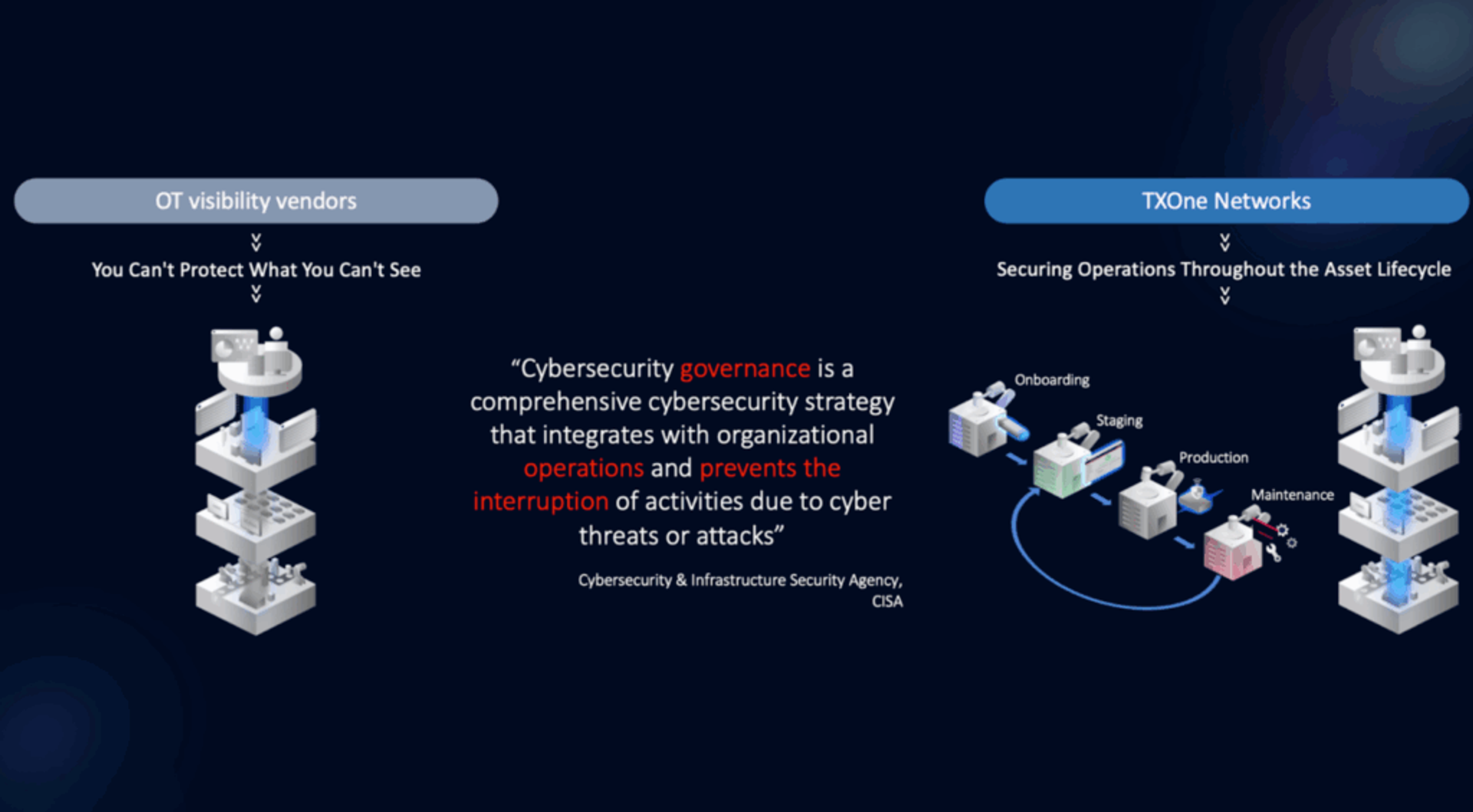
OT Zero Trust: TXOne's Asset-Centric OT Security Across the Industrial Lifecycle
TXOne Networks applies OT zero trust — never assuming an asset is trustworthy because of where it sits — across the entire industrial asset lifecycle rather than at a single control point.
| Stage | Risk | TXOne approach |
|---|---|---|
| Onboarding | New equipment and contractor devices arrive carrying malware | Portable Inspector scans laptops, controllers, and tools before they touch the plant network; results feed ElementOne for audit trails |
| Staging | Systems are configured and tested before deployment | EdgeIPS micro-segmentation blocks unauthorized OT protocol traffic during factory acceptance testing; Safe Port sanitizes removable media at facility entry |
| Production | Live systems must stay available and unaltered | Stellar Protect enforces allowlisting on HMIs, historians, and engineering stations, preventing ransomware lateral movement while lines run at full speed |
| Maintenance | Aging assets need updates without downtime | Stellar Protect secures legacy Windows HMIs through operation lockdown, scheduled maintenance windows, and quarantine — extending asset life without hardware replacement. SenninOne adds the governance layer on top: CVE-to-asset ticketing, VSAR risk scoring, and audit-ready reporting across sites. |
Hardening at the staging phase should be measured against standards that actually apply to industrial assets — IEC 62443-3-3 and -4-2 for system and component security requirements, NERC CIP-007 for systems security management in the electric sector, or CIS Benchmarks for host hardening.
The intent throughout is zero disruption: security that protects the process without becoming another source of downtime.
KPIs & Metrics That Prove OT Security ROI
Demonstrating return on OT security investment requires metrics that operations leadership recognizes as meaningful.
| Metric | How to calculate | What good looks like |
|---|---|---|
| Mean Time to Detect (MTTD) | Total detection time across incidents ÷ number of incidents | Trending down quarter over quarter; measured in minutes, not days |
| Mean Time to Respond (MTTR) | Total response time ÷ number of incidents | Sustained reduction; response bounded by playbook, not by investigation |
| High-risk asset coverage | (Covered high-risk assets ÷ total critical assets) × 100 | Rising toward complete coverage of PLCs, DCS, and safety systems |
| Asset inventory accuracy | (Discovered assets matching inventory ÷ total discovered) × 100 | Above 95%, verified by periodic discovery |
| Incident breakdown by type | Tally monthly by category: malware, unauthorized access, misconfiguration | Shifting mix from malware toward configuration issues indicates controls are working |
| Unplanned downtime attributable to cyber | Hours of cyber-caused production loss per period | Trending to zero |
| Patch/compensating-control coverage | (Vulnerable assets with a compensating control ÷ total vulnerable assets) × 100 | Near-complete coverage for assets that cannot be patched |
To estimate financial impact per prevented incident, calculate avoided downtime hours × hourly production value, plus incident-response and remediation cost. Using your own production economics produces a defensible number; industry averages rarely survive scrutiny from a CFO. For a deeper treatment, see cybersecurity metrics and the path to OT security maturity.
Future Trends to Watch for in OT Cybersecurity
Four shifts are shaping OT cybersecurity through 2026 and beyond.
5G & Private Cellular in OT
Private 5G networks are replacing fixed cabling for mobile robotics, AGVs, and distributed sensing. This removes the implicit security of a physical cable and makes traffic visibility a design requirement rather than an assumption. Monitoring across industrial protocols becomes essential when the transport is shared and wireless.
AI/ML Anomaly Detection & Predictive Maintenance
Machine learning is being applied to establish behavioral baselines and flag deviations that signature-based tools miss, and to predict equipment failure. The security caveat is that the models themselves become assets worth attacking — data poisoning and model manipulation are real concerns as ML moves into control-adjacent decisions.
Edge-to-Cloud Convergence
OT data increasingly flows to cloud analytics, and remote operations centers increasingly reach back into plants. Making this safe depends on brokered architecture, strong authentication, and clear boundaries about what may traverse in each direction.
Post-Quantum Cryptography Planning
Cryptographically relevant quantum computing threatens the algorithms protecting long-lived systems. Because OT assets remain in service for decades, equipment specified today may still be running when current encryption becomes breakable. NIST published its first post-quantum cryptography standards in August 2024. For OT, the practical near-term step is inventory: knowing where cryptography is used and which assets could not be updated if the algorithms changed.
OT Cybersecurity FAQs
What is OT cyber security?
OT cyber security is the practice of protecting operational technology — the hardware and software that monitors and controls physical processes — from cyber threats. It covers industrial control systems, connected plant equipment, and OT networks, with the goal of keeping industrial operations safe, reliable, and continuously available. Unlike IT security, which prioritizes data confidentiality, OT cyber security prioritizes safety and operational availability.
What does OT security stand for?
OT security stands for Operational Technology security. It refers to the practices, technologies, and policies used to protect industrial control systems, physical processes, and connected operational assets from cyber threats. Unlike IT security, which mainly protects data and business systems, OT security focuses on keeping industrial operations safe, reliable, and continuously available.
What is the meaning of OT security?
The meaning of OT security is the protection of systems that monitor or control physical operations, such as factories, power plants, water treatment facilities, and transportation infrastructure. OT security is designed to reduce cyber risk while maintaining operational continuity, worker safety, and system reliability. In other words, OT security helps organizations secure the technology that keeps real-world processes running.
What is operational technology (OT)?
Operational technology is the hardware and software that detects or causes changes in physical processes through direct monitoring and control of industrial equipment. OT includes programmable logic controllers (PLCs), SCADA systems, distributed control systems (DCS), human-machine interfaces (HMIs), remote terminal units (RTUs), and safety instrumented systems that run manufacturing, energy, water, and transportation infrastructure.
What is an OT network?
An OT network is the communications infrastructure connecting industrial control devices — PLCs, HMIs, RTUs, sensors, and actuators — to each other and to supervisory systems. OT networks run industrial protocols such as Modbus, DNP3, and OPC UA, which generally lack native authentication. OT network security therefore relies on segmentation, controlled conduits between zones, and inspection of industrial traffic.
What is the difference between OT security and IT security?
The main difference between OT security and IT security is their primary objective. IT security focuses on protecting data confidentiality, integrity, and availability, while OT security prioritizes safety, operational availability, and process integrity. OT environments often include legacy systems, industrial protocols, and equipment that cannot be patched or rebooted easily, so OT cybersecurity requires a more cautious and operations-aware approach than traditional IT security.
Why is OT threat detection important?
OT threat detection is important because cyber incidents in industrial environments can lead to physical disruption, equipment damage, production downtime, or safety risks. Early detection helps organizations identify abnormal activity, such as unauthorized PLC commands or suspicious remote access, before it impacts critical processes. Effective OT threat detection also supports faster response, reduces operational disruption, and strengthens resilience in connected industrial networks.
What is OT security monitoring?
OT security monitoring is the continuous observation of industrial networks and endpoints to identify activity that deviates from normal operations. It watches for abnormal PLC commands, unusual industrial traffic, and unauthorized access attempts. Because industrial protocols often lack authentication, OT security monitoring focuses on establishing a behavioral baseline for each asset and flagging departures from it, rather than relying on signatures alone.
What are OT security best practices?
OT security best practices include maintaining an accurate asset inventory, segmenting OT networks into zones and conduits, securing remote access with multi-factor authentication, monitoring industrial environments continuously, and applying compensating controls such as virtual patching for legacy or unpatchable systems. Organizations should also align IT and OT teams, follow frameworks such as NIST CSF 2.0 or IEC 62443, and build programs that support uptime and safety.
Tags