The real problem isn’t what you can see. It’s what you can’t stop.
5 MIN READ
Your Detection Tools Are Working Perfectly
Your visibility platforms are doing their job. They discover assets. They monitor protocols. They detect threats. They generate alerts. They’re sophisticated, comprehensive, and working exactly as designed.
And yet, 100% of ransomware incidents they monitored last year still caused operational shutdowns.
Read that again. Not 80%. Not 90%. Every single one.
That’s not a failure of detection. It’s a fundamental architectural limitation. Your tools see threats. They just can’t stop them.
The Math Nobody Talks About
In 2025, industry-leading OT security platforms responded to ransomware incidents across manufacturing, utilities, and critical infrastructure. Their detection capabilities identified every attack. Their threat intelligence was comprehensive. Their security teams were experts.
The results:
- 75% resulted in a partial operational shutdown
- 25% resulted in a full operational shutdown
- 100% caused production disruption
(Source: Dragos 2025 OT Cybersecurity Year in Review)
The detection worked flawlessly. Prevention simply wasn’t part of the architecture.
This isn’t a criticism of those platforms. They were designed to see threats and alert your team. The problem is the gap between “alert received” and “threat stopped.”
The 45-Minute Window Where Attacks Win
Here’s what happens between “alert received” and “threat stopped”:
(Timeline abstracted from TXOne/Omdia and Frost & Sullivan 2024 survey data)
| Minute | Action |
| 0-2 | Alert generated. SOC notified. |
| 2-10 | Is this real? In OT, a false positive that triggers the wrong response can shut down production. Your team investigates. Validation is critical. |
| 10-25 | Coordination begins. Security needs OT approval. Firewall team needs policy changes. NAC operators need rules. Everyone needs to agree the action won’t disrupt production. |
| 25-40 | Enforcement activates. Rules deployed. Policies pushed. Blocking enabled. |
| 40-45 | Threat blocked. If you’re lucky. |
In that window, ransomware encrypts. Attackers move laterally. Commands reach PLCs. Operations stop.
Meanwhile, your detection platform watched the whole thing happen.
The Question You Should Be Asking
The OT security market has spent years telling you, “you can’t protect what you can’t see.”
Fair point. Visibility matters.
But visibility is no longer the problem. You invested in asset discovery. You deployed network monitoring. You have threat detection across your industrial environment.
You can see attacks.
But you can’t stop them before they stop you.
That’s not a visibility gap. That’s a prevention gap.
And detection platforms don’t close it. They’re architecturally designed to alert, not block. They connect via SPAN ports that copy traffic for observation; they cannot physically intercept it. When they detect a threat, they hand it off to separate firewalls, NAC solutions, or endpoint tools that require manual coordination.
The 45-minute window isn’t a bug. It’s working as designed. That’s the problem.
What Prevention-First Actually Looks Like
Closing the prevention gap requires a different architecture:
Inline, not passive. Security that sits in the traffic path and blocks threats automatically, not after a coordination meeting.
Unified, not fragmented. Discovery, assessment, and prevention in one platform—not three vendors pointing fingers during an incident.
Operations-safe, not operations-risky. Hardware bypass technology that guarantees production continuity even during security system maintenance – not enforcement tools that become single points of failure.
The difference: Detection platforms show you threats executing. Prevention platforms stop threats before execution.
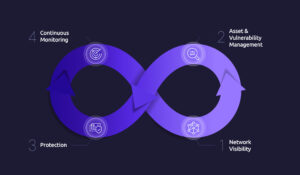
One architecture logs incidents. The other prevents them. Here’s what that unified architecture looks like:
The Real Visibility Gap
The industry calls it a “visibility gap”, suggesting you need better detection.
You don’t.
The real gap is architectural. It’s the 45-minute space between when your tools see a threat and when any tool can stop it. It’s the coordination overhead between security teams and enforcement tools. It’s the assumption that someone, somewhere, will respond fast enough.
In 2024, that assumption failed every time it was tested.
Your visibility tools see everything.
They stop nothing.
That’s the gap worth closing.
See the Difference
Stop evaluating visibility. Start evaluating prevention.
We’ll be going into more detail about this topic at S4x26 this year.
—