By Dmitri Belotchkine, Senior Technical Director – TXOne Networks
Industrial organizations are undergoing rapid digital transformation. IT and OT convergence happens on different levels as business demands higher efficiency and productivity, leaner raw material and supply chain management; and application of innovative emerging technology. As a result, the OT systems and underlying software we use on the shop floor become increasingly interconnected and more exposed to cybersecurity attacks.
With AI-driven initiatives like Anthropic’s Project Glasswing—powered by its Claude Mythos model—now able to discover vulnerabilities at unprecedented pace and scale, the cost and time required for attackers to exploit security weaknesses are falling sharply. As a result, a flaw introduced in code or product design can have a far greater impact than ever before.
Working with organizations across Europe — manufacturing plants, energy facilities, transportation systems — one thing is consistently clear: cybersecurity cannot be treated as an afterthought. It must be built into the technologies that support industrial operations from the very beginning.
That is why achieving IEC 62443-4-1 certification is a significant milestone for TXOne Networks and for the customers we support.
Security Must Start in the Development Process
The IEC 62443 family of standards is the global reference framework for cybersecurity in Industrial Automation and Control Systems (IACS). Within this framework, IEC 62443-4-1 focuses on the Secure Development Lifecycle (SDL)—the processes vendors must follow to ensure cybersecurity is integrated into product development by design.
For industrial organizations evaluating cybersecurity technologies, this matters more than ever.
The certification validates that TXOne follows structured processes designed to embed security throughout the product lifecycle, including:
- Security requirements defined during product design
- Threat modeling and risk analysis
- Secure coding and architecture practices
- Rigorous security testing and validation
- Continuous vulnerability management and patch processes
In practical terms, this means security is engineered into our solutions, not bolted on afterward.
For asset owners and operators, that provides greater confidence that the technologies protecting their production environments have been designed with cybersecurity as a core principle.
OT Environments Require a Different Security Approach
One of the biggest challenges in industrial cybersecurity is that OT environments operate under very different constraints compared to traditional IT systems.
In many factories and critical infrastructure environments:
- Systems run continuously, often 24/7
- Production depends on legacy equipment and specialized protocols
- Downtime can impact safety, availability, and production output
In these environments, applying traditional IT security practices without adaptation can introduce operational risks. For example, aggressive vulnerability scans, forced updates, or system reboots may disrupt production processes.
That is why OT security solutions must be designed with operations-first principles.
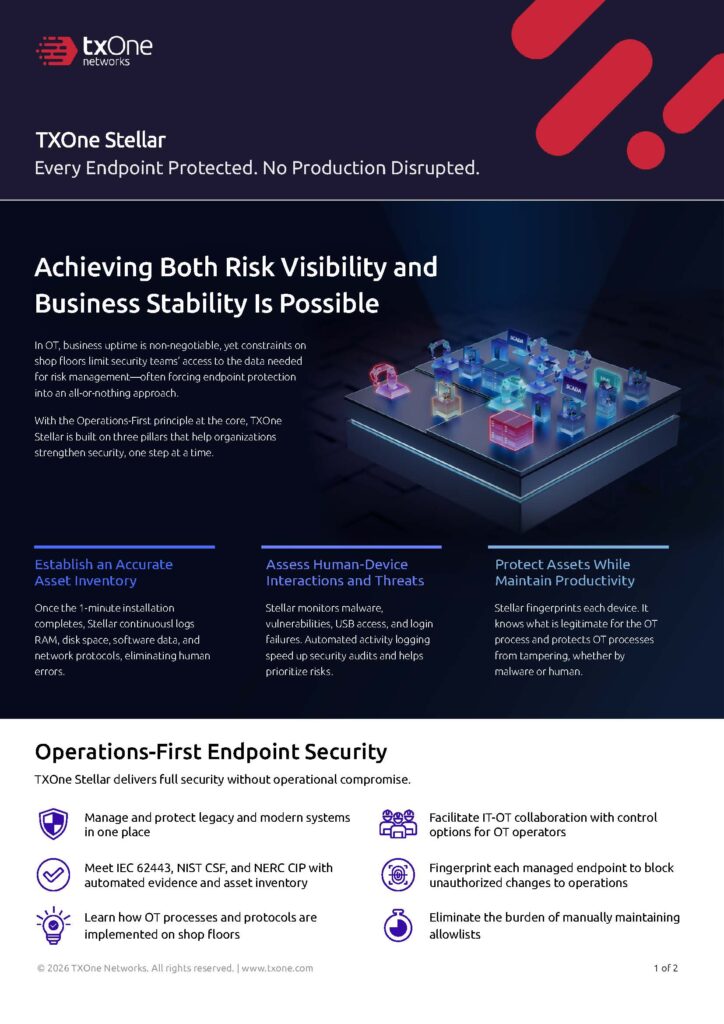
At TXOne Networks, our approach focuses on enabling organizations to strengthen cybersecurity while preserving operational continuity. In practice, this means helping industrial teams:
- Discover and build industrial assets inventory across production networks
- Assess software and configuration vulnerabilities, measure cybersecurity exposure, and identify risks in OT systems
- Protect endpoints, processes, and industrial networks without disrupting operations
Supporting Industrial Cyber Resilience
Across Europe and globally, cyber threats targeting industrial organizations continue to grow in both frequency and sophistication. At the same time, regulatory frameworks and industry standards are evolving to require stronger security practices across supply chains.
From my perspective working with customers in the region, organizations are increasingly looking for vendors that can demonstrate security maturity, transparency, and adherence to internationally recognized standards.
Achieving IEC 62443-4-1 certification is a meaningful step in that direction.
It reinforces TXOne Networks’ commitment to developing cybersecurity technologies that are secure by design and specifically built for industrial environments.
Many of our customers are machine builders and OEMs who, in turn, rely on TXOne technology to build security into their own products and machinery by design and by default.
As industrial organizations continue their digital transformation journeys, the goal is not simply to deploy more security tools. It is to ensure that the technologies protecting critical operations are developed with the realities of OT in mind.
Because in industrial environments, cybersecurity is ultimately about protecting what matters most: the continuity and safety of operations.
Register for the webinar to find out more! https://www.brighttalk.com/webcast/20751/670099?utm_source=blog