
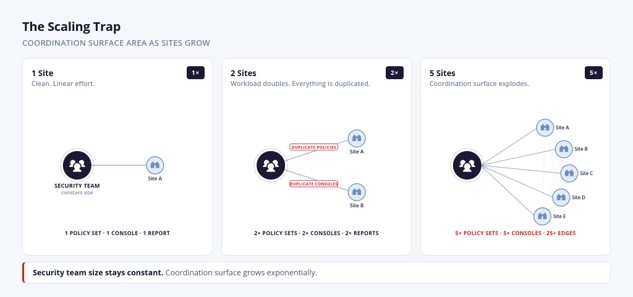
The first site is easy. You deploy OT security tools, configure policies, run an assessment, and produce a report. The team manages it directly. It works.
The second site doubles the workload. Different assets, different configurations, different operational constraints. A second console. A second set of policies to maintain. A second site administrator to coordinate with.
By the fifth site, the program is only held together with spreadsheets and email chains.
The Scaling Trap
It is not about whether you can protect individual sites. It is about what happens to your program when you try to protect all of them at once.
The Overhead That Accumulates
The Compound Argument
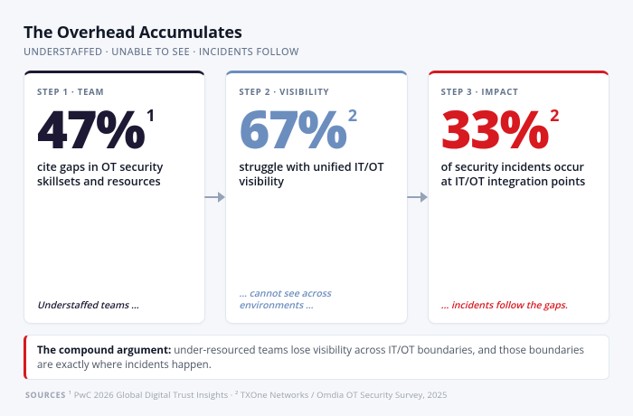
Most OT security teams are small. Two or three people covering multiple facilities is common. 47% of organizations cite gaps in OT security skillsets and resources1. Those teams spend their time aggregating data from separate consoles, coordinating policy changes across locations, and preparing compliance documentation.
Every new site adds another console, another policy set, and another round of manual coordination. The work compounds. The headcount does not.
67% of organizations struggle with unified IT/OT visibility2. The IT security team has its tools. The OT team has different tools. Neither has a shared operational picture. Policy changes that should take hours take weeks because they require manual replication across locations.
The Consistency Problem
When each site manages its own security independently, policy enforcement becomes inconsistent. One site applies a firmware update. Another delay occurs because of a production freeze. A third never received the notification because the coordination happened over email, and someone was on vacation.
33% of security incidents occur at IT/OT integration points2. These are not exotic attacks. They are the predictable result of inconsistent policy enforcement across environments that should be governed centrally but are not.
The risk is not theoretical. When an audit team asks for evidence that a security policy is applied consistently across all locations, the two-person OT security team must pull data from every site, manually normalize it, and compile it into a report. That process can take weeks for every audit cycle.
What Scaling Actually Requires
Scaling an OT security program requires centralized policy management so that a change made once propagates across all sites. It requires site-level approval workflows so that local operations teams can review and approve changes before they reach production. And it requires unified compliance reporting so that audit preparation is a query, not a data aggregation project.
Without those things, every new site is a net increase in management burden. The program does not scale. The team burns out. Findings accumulate unaddressed.
Sources:
- PwC 2026 Global Digital Trust Insights
- TXOne Networks / Omdia OT Security Survey, 2025